Three kids who would not sit down
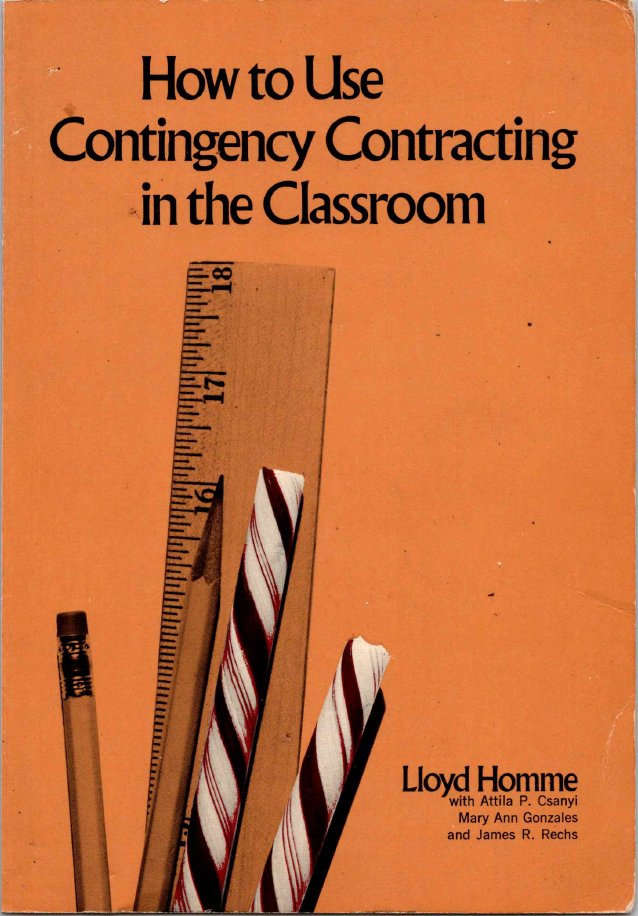
How to Use Contingency Contracting in the Classroom, by Lloyd Homme with Attila Csanyi, Mary Ann Gonzales and James Rechs. Research Press, revised edition, 1970. It grew out of US Office of Education research grants and was field tested with teachers. Wesley Becker of the University of Illinois wrote the introduction, arguing that school failure has causes in how we teach and motivate, not in labels like low intelligence.
The book is written as programmed instruction: short chunks, quick checks, skip what you already know. That is the format of this course too.
Make a prediction
Before you read on: what do you think Homme used as the reward for sitting quietly?
If first you do X, then you may do Y
You do not guess the reward. You watch what students choose when they have a free moment, and the student is the best source of information about what works right now. A reward can even be an academic activity. If a student prefers reading to arithmetic, the contract is ten problems first, then ten minutes with the novel. If the student prefers arithmetic, flip it. This matters most for the student who seems to want nothing from school. They still want something.
Positive or negative?
Tap the type of contract for each statement.
Find what your hardest-to-reach student already chooses
Think of one student in your class who is hardest to reach. Please do not use their name. When they get a free minute, what do they choose to do? List three specific things.
What makes a reward actually work
The book also lists momentary rewards: getting a drink, going to a locker, erasing the board. These are things students already ask for all day. The move is to make them contingent. First finish the task, then go.
And watch for satiation. A student who picks the same reward every day will wear it out, so rotate the menu and take suggestions from students.
Grandma's Law and the ten rules
First, the book's answer to "isn't it wrong to reward kids for what they should be doing anyway?" Children learn better and more willingly when something good follows a hard task. School already hands out fun things. The only real difference is when.
Second, the rules work all the time, whether you notice them or not. Whatever follows a behavior strengthens it. The book's advice for unwanted behavior is to make sure it never pays off, and to reward something that cannot happen at the same time.
Which rule is broken?
Pick the rule each contract breaks. You will see a stronger version after you get it.
The whole class problem
Same objective, tiered task cards. Everyone aims at the same standard, but cards come in two or three levels, each with a small amount of work.
A progress check you can grade in seconds. The book says two to five objective items per task, ideally self-checked or swapped with a partner.
Rewards start when you pass. No waiting for the slowest student. Early finishers go to the menu, and a clock signal brings everyone back together.
Two or more cycles per period. The book says at least two task units and two reward periods in a fifty minute class, which fits our periods.
Launch it backwards. The book teaches the system in reverse, like teaching the word Washington by saying ton first. On day one, let students experience the reward and the menu first, then show how a passed check opens the menu, then add the task.
Start the thorny student smaller, inside the same system. The student who is hardest to reach gets the same cards, the same menu and the same signal as everyone else, so nobody is singled out. What changes is the size of the first task. Make it small enough that passing is almost certain, then grow it.
Warm strictness, in contract form. The strict part is the standard: no reward without the work, every time. The warm part is how you set it up. The student helps choose the menu, and you hand over the reward without a lecture.
Plan one period
Slide to set your class length, how many task and reward cycles you want, and reward time. The bar redraws and flags anything the book would question. We assume three minutes to launch and one minute per progress check.
Which design would you run?
24 students, 50 minute period, one standard. Pick the best design.
Same class, one student who will not start
Same 24 students, same design. One student, Yusuf, sits with his head down and has not started a task in three days. Everyone else is moving. What do you do?
Handing over the controls
In a Job Corps program the book describes, students picked their own task cards. Then they rolled two dice to decide how long their reward lasted. Try it with one die plus two, which gives three to eight minutes, the same range the book suggests for varied reward times.
In a whole class, level one is where you start. Level two can begin in week two. Let the class vote on menu items, or let each student choose between a four problem card and a six problem card. For a thorny student, a real choice early, like which of two cards, is often what makes starting feel safe. Keep a visible record of completed contracts for each student. The book notes that seeing your own progress is itself rewarding.
Your first student voice move
When a contract stops working
When a student finishes early, let them enjoy the extra time that day. Lengthen tomorrow's contract and frame it as a step up in status. When a student tries hard and still misses after two or three attempts, give an easier task they can pass, then the reward. Entry to the reward area must always follow a real performance.
Diagnose four classrooms
What gives you pause?
Build your whole-class contract
Your contract card
Nice work
Your plan
Read the book for the full set of programmed exercises, flowcharts and sample record sheets. Questions or want a second set of eyes on your first run? Email info@abrahameducation.com.
جزاك الله خيرا (JazakAllah khair, may God reward you with good) for your time.